

Why Choose Natural Fabrics for Beachwear: A 2026 Guide
Table of Contents
- Why Choose Natural Fabrics for Beachwear: The Core Trade-Offs
- Natural vs. Synthetic Swimwear: How the Fibers Actually Differ
- The Best Natural Fabric for Swimsuits: Hemp, Linen, and Bamboo Compared
- Cotton Beachwear Pros and Cons: What It Does Well and Where It Falls Short
- Environmental Impact: Biodegradability, Microfiber Shedding, and Certification
- Fiber Blends and Construction: Where Natural Meets Synthetic
- Natural Fiber Swimwear Care: Making Each Piece Last
- Picking Natural Beachwear for Your Coast Days
- Frequently Asked Questions
Last Updated: October 21, 2026
Why Choose Natural Fabrics for Beachwear: The Core Trade-Offs
The short answer: natural fabrics for beachwear win on skin feel, breathability, and end-of-life waste, but they lose on stretch and drying speed. That trade-off is the whole story. This guide from Salt and Sand Surf Shop breaks down where natural fibers earn their place in your beach bag and where a synthetic blend still makes sense.

Here's what most guides get wrong: they frame natural versus synthetic as a moral contest. It isn't. It's an engineering decision, and the right pick depends on whether you're paddling out or walking the boardwalk.
Natural fabrics are textiles made from plant or animal fibers, including cotton, hemp, linen, and bamboo, rather than petroleum-derived synthetics.
Natural vs. Synthetic Swimwear: How the Fibers Actually Differ
Synthetic fabrics are engineered from polymer fibers, while natural fabrics come from plants. That origin difference drives everything downstream: how the cloth breathes, how it handles saltwater, and what happens to it after you retire it. But the fiber origin only sets the starting point. What you actually feel at the beach is determined by four measurable behaviors: airflow when dry, water uptake when wet, stretch recovery, and drying speed. Here is how each one plays out.
Breathability, Airflow, and Skin Feel
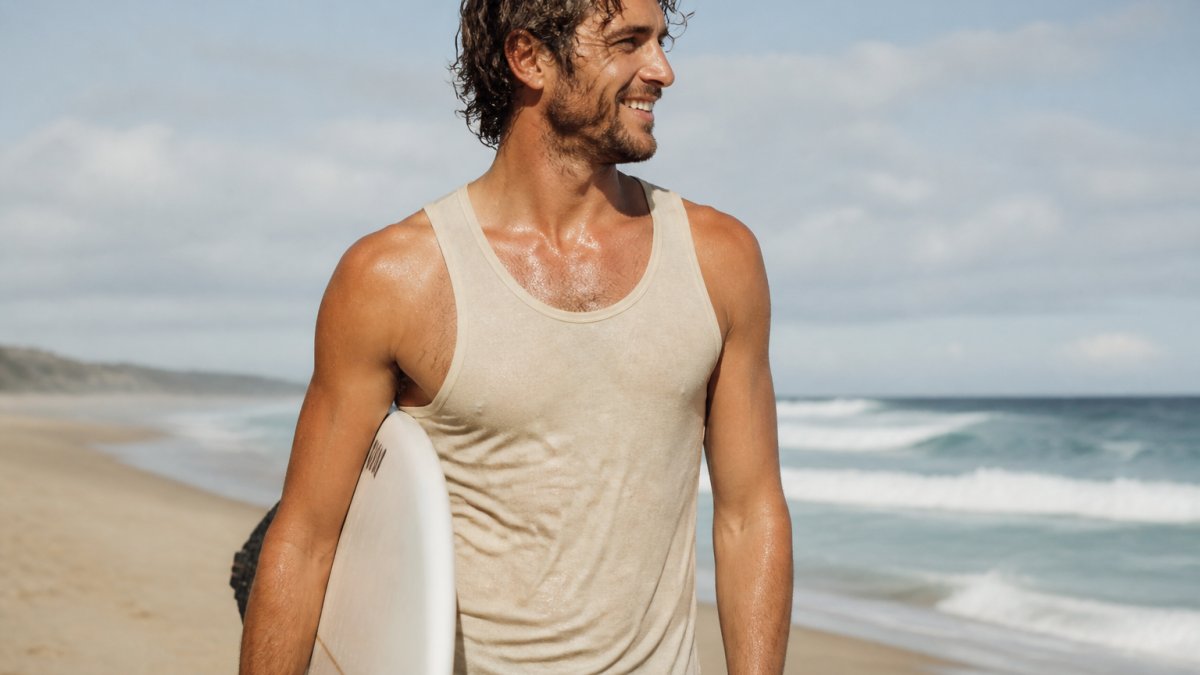
Natural fibers generally let air move through the weave, which keeps skin cooler when you're dry and out of the water. The mechanism is structural: cotton, linen, and hemp fibers have irregular cross-sections and a staple length that creates tiny air pockets in the yarn, and the knit or weave leaves gaps between yarns. Air passes through those gaps and carries moisture vapor away from skin. Synthetic filaments are smoother and more uniform, and a tight knit traps the humid layer next to your body, which is why polyester can feel clammy in heat even when it is technically wicking.
That difference shows up fastest in the hours you are not swimming: the walk to the sand, the post-surf hang, the boardwalk. For a garment you wear all day in sun, airflow matters more than almost any other property.

Wet Performance, Drying Time, and Stretch
This is where the honest comparison lives, and it is where most guides get vague. Here is what actually happens when natural and synthetic beachwear get wet.
Water uptake. Cotton can absorb a large fraction of its own weight in water; the fiber swells, the garment gains heft, and the knit relaxes. Linen absorbs quickly but releases water faster because the fiber is stiffer and the weave is more open. Hemp behaves like linen but with more body. Polyester and nylon absorb very little water at the fiber level, so a synthetic rash guard stays light and clings rather than sags.
Stretch and recovery. Most natural fibers have low elasticity and poor recovery, meaning a wet cotton tee stretched over your shoulders tends to stay stretched until it dries. Synthetics, especially when blended with a small percentage of elastane, snap back to shape. That recovery is the single biggest reason performance swimsuits are synthetic.
Opacity when wet. A light-colored cotton or linen garment can become semi-transparent when soaked. If a piece is going to get wet, look for a tighter knit, a darker color, or a lining.
Drying time. In still, humid air, a heavy cotton tee can stay damp for hours; a thin synthetic dries in a fraction of that time. Linen and hemp dry faster than cotton because the weave is more open, but none of them match a synthetic performance knit.
Shape retention. Side seams, shoulder taping, and a stable knit hold shape better than a loose jersey. Construction can partly compensate for a fiber's weak recovery.
The Practical Rule
Match the fiber to the exposure. For close-fitting swimwear that will be submerged repeatedly, a synthetic or a synthetic-dominant blend is the engineering answer. For loose beachwear that gets splashed but not soaked, natural fibers win on comfort, breathability, and end-of-life. The mistake is treating the choice as all-or-nothing when most beach bags need both.
The Best Natural Fabric for Swimsuits: Hemp, Linen, and Bamboo Compared
There is no single best natural fabric for swimsuits. Hemp wins on durability, linen on airflow, and bamboo on softness. Match the fiber to the job.
| Fabric | Strength | Drying Speed | Best For |
|---|---|---|---|
| Hemp | High | Moderate | Durable cover-ups, tough wear |
| Linen | Moderate | Fast for a natural fiber | Hot, dry days and airflow |
| Bamboo | Moderate | Moderate | Softness against skin |
| Organic cotton | Moderate | Slow | Tees and casual beachwear |
Hemp is the toughest of the group and softens with every wash. Linen breathes better than anything else on this list, though it wrinkles. Bamboo feels silky next to skin. Organic cotton is the comfort default, but it's the slowest to dry.
Cotton Beachwear Pros and Cons: What It Does Well and Where It Falls Short
Cotton is the most familiar natural fiber and the easiest to wear daily. It's soft, breathable, and holds up to repeated washing. The catch is moisture: cotton absorbs water and dries slowly, so it's a poor pick for actual swimming.
Pros:
- Soft against skin and comfortable all day
- Breathable in heat
- Easy to care for and widely available
Cons:
- Absorbs water and dries slowly
- Can sag when soaked
- Shrinks without pre-shrunk construction
Our Ride the First Wave Tee uses 100% Airlume combed and ring-spun cotton at 4.2 oz./yd.², pre-shrunk, which is exactly the kind of piece cotton does best: post-surf hangs, not paddling out.

Check for "pre-shrunk" on the label. Combed and ring-spun cotton with pre-shrunk finishing holds its fit far better after the first few washes than standard cotton knits.
Environmental Impact: Biodegradability, Microfiber Shedding, and Certification
Natural fibers generally biodegrade at end of life, while synthetic fabrics can shed microfibers into waterways during washing. That is the core environmental case for natural fabrics, and it is a real one. But the case is stronger when you separate what happens at the fiber level from what happens to the finished garment, because the two are not the same story.
Fiber-level impacts. Growing cotton, hemp, and flax takes land, water, and in conventional systems, agricultural chemicals. Hemp and flax are typically lower-input crops than conventional cotton, but "lower" is not "zero." Organic certification changes the chemical picture, not the water picture. On the synthetic side, polyester and nylon are petroleum-derived, and producing them is energy-intensive.
Finished-garment impacts. A garment's footprint is set by more than its fiber: dyeing, finishing, lining, trims, and the elastane content that gives swimwear its stretch. A 92% cotton / 8% elastane blend does not biodegrade like pure cotton, and a natural-fiber garment with heavy synthetic finishing behaves differently at end of life than an undyed, unblended one. This is the distinction most marketing skips.
Microfiber shedding. Synthetic knits shed microfibers in the wash, and those fibers are a documented contributor to microplastic pollution in waterways. Natural fibers also shed, but the shed fibers biodegrade. Guppyfriend-style wash bags and front-loading machines with lower agitation reduce shedding; they do not eliminate it.
End of life. Pure natural fibers can break down in industrial composting or, over time, in landfill. Blends complicate this: a cotton-polyester mix is hard to recycle mechanically and does not compost cleanly. That is a real cost of the stretch that makes a garment perform.
Certification and labels. Certification helps cut through the noise. Look for GOTS organic textile certification on cotton, which verifies organic status from field to finished product, and check for fiber-content disclosure required under FTC's textile labeling rules. The label is your first source of truth, but it tells you fiber content, not water use or dye chemistry.
"Natural" and "sustainable" are not synonyms. A natural fiber garment with heavy synthetic finishing behaves differently at end of life than a certified organic one. Read the fiber content and certification, not just the marketing, and judge the finished garment, not the fiber alone.
Fiber Blends and Construction: Where Natural Meets Synthetic
Blends exist because pure natural fibers can't do everything. A cotton-polyester mix gains stretch and faster drying while keeping some softness. The trade-off is that blends are harder to recycle and biodegrade less cleanly than pure fibers.
Construction matters as much as fiber. [Side-seamed construction and shoulder-to-shoulder taping, both used in our Beach Life Tee, hold a garment's shape through repeated wear](https://salt-and-sand-surf-shop.myshopify.com/products/beach-life-tee) and washing. A well-built cotton tee outlasts a poorly built blend every time.
Natural Fiber Swimwear Care: Making Each Piece Last
Natural fiber swimwear care comes down to three habits: rinse after saltwater, wash cold, and dry in shade. Salt and chlorine break down fibers over time, and heat speeds that up.
- Rinse in fresh water after every ocean or pool day
- Wash cold on a gentle cycle
- Skip the dryer; air dry flat in shade
- Store dry, never damp
Cost per wear is the metric that matters. A piece you care for properly lasts seasons, which beats replacing a cheap one every summer.
Picking Natural Beachwear for Your Coast Days
Choosing natural fabrics for beachwear is really about matching fiber to use. Wear natural fibers for the hours around the water, and reach for a synthetic blend when you're actually swimming.
At Salt and Sand Surf Shop, our coastal-inspired pieces lean on soft, breathable cotton built for exactly that in-between time: the walk to the sand, the post-surf hang, the sunset. Our Beach Life Tank Top and Vintage Script Tank Top both run $19.95, and every purchase supports the Surfrider Foundation and local charities protecting beaches and waves.
Frequently Asked Questions
Which fabric is best for beachwear?
It depends on what you're doing. For dry beach time, boardwalk walks, and post-surf hangs, natural fabrics like cotton, linen, and hemp win on breathability and softness. For actual time in the water, a natural or blended fabric with some stretch holds shape better than pure cotton, which gets heavy when soaked. Many beachgoers split it: natural fibers for the day, a dedicated swim layer for the surf. Look at the label and match the fiber to the activity.
Can you swim in cotton or linen beachwear?
You can, but expect trade-offs. Cotton absorbs water and gets heavy, dries slowly, and clings once wet, so it's better for lounging than laps. Linen dries faster than cotton and feels cooler in heat, but it wrinkles and has little stretch. Neither is chlorine or saltwater resistant the way synthetic swim fabric is. For a quick dip and a long beach day, a cotton or linen tee or tank works fine. For repeated surf sessions, choose a purpose-built swim layer.
Are natural fabrics comfortable in hot, humid weather?
Yes, generally more so than synthetics for dry wear. Cotton and linen breathe and move air against the skin, which helps in heat and humidity. Hemp is strong and breathable but starts stiffer and softens with washing. The catch is moisture: once a natural fabric is soaked, it stays wet longer than a quick-drying synthetic. So natural fabrics shine on hot dry days and casual beach wear, while synthetics handle sustained sweat and water better.
How should you care for natural-fiber beachwear?
Rinse salt and sand out with cool water after each beach day, then wash cold on a gentle cycle with a mild detergent. Skip the dryer for cotton and linen, since heat shrinks and weakens fibers; hang dry in shade to protect color. Hemp softens over time with regular washing. Store folded rather than on a hanger to keep the shape. Done this way, a cotton tee or tank can last several seasons instead of one.
The hardest part of building a beach wardrobe isn't finding natural fabrics. It's finding pieces comfortable enough to wear all day and durable enough to survive the sand, salt, and sun. That's what we build at Salt and Sand Surf Shop: soft, breathable cotton tees and tanks with timeless coastal design, backed by support for the Surfrider Foundation. Shop now and find your next coast-day staple.